Mapping Earth Changes Over 30 Years
Drawing on millions of images taken by eight NASA Landsat satellites, Google has created a “global, zoomable time lapse of Earth’s surface” that show us the changes — shocking and scary — that have occurred around the world as a result of global warming and urbanization.
In the Landsat program, surveillance spacecraft were put to use not for investigating what’s going on in outer space, but to keep track of what is happening to the Earth. NASA launched the first Landsat satellite in 1972 specifically for “public monitoring of how the human species was altering the surface of the planet.”

In 2008, the U.S. government ruled that the Landsat pictures should be available for free; one had previously had to pay to access them. Google contacted the U.S. Geological Service about using the images and also sought to gain access to even more photos (in the form of traditional prints and negatives) from Landsat ground stations around the world. It took six months to digitize everything and more to reprocess them.
You can now see the results via Google Earth Engine. As Time magazine comments, the pictures
…tell the pretty and not-so-pretty story of a finite planet and how its residents are treating it — razing even as we build, destroying even as we preserve. It takes a certain amount of courage to look at the videos, but once you start, it’s impossible to look away.
The Timelapse image of the rain forest in the state of Rondonia in western Brazil shows not only how an area the size of West Virginia (nearly 25,000 sq. miles) has disappeared from 1978 to 2003, but also the “fishbone pattern” in which deforestation occurs: loggers first make a path in the forest. This thickens and grows and then more paths are built and more, and more, and more.
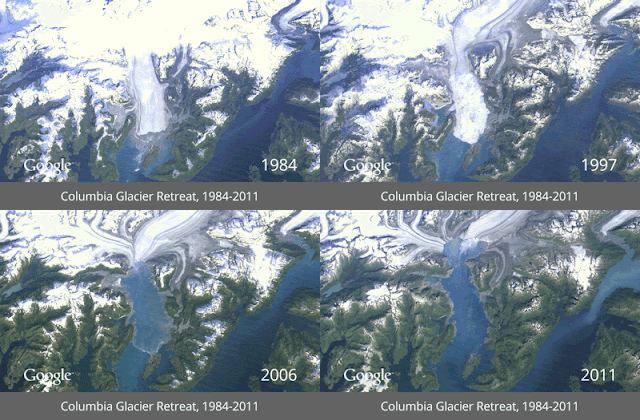
For a too-clear illustration of how global warming has caused rapid change with long-term effects, you need look at only the image of the retreat of the Columbia Glacier in Alaska from 1984 – 2012. Since it was first observed in 1794, the glacier’s extent remained unchanged until the latter half of the 20th century, as you can see. At one point in 2001, the glacier was shrinking at an estimated speed of 98 ft. (30 meters) per day. In just a few decades (within the lifetime of many of us), the glacier has lost about 12 miles of its length and nearly 1,300 feet of its thickness.
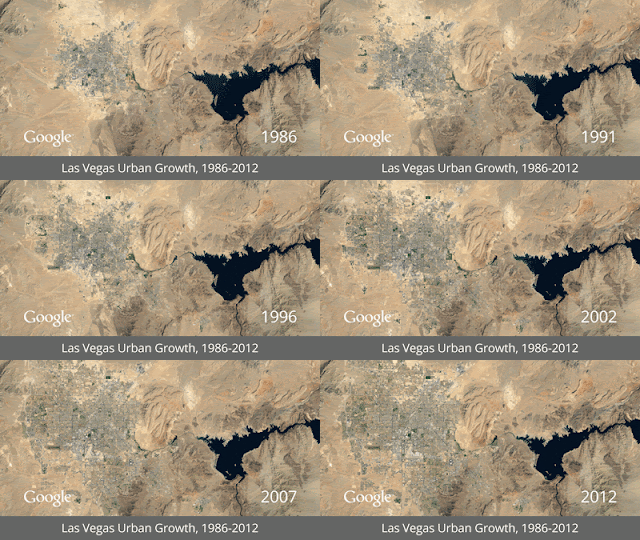
The Google images also show how urbanization is rapidly changing the world around us. More people than ever in human history now live in cities, having left villages and farming for cramped housing in urban centers in the hope of better job prospects. Just one example is Las Vegas, which has grown from a population of 500,000 in 1980 to about 2 million now. From 2000 to 2o1o, its population grew by nearly 50 percent, making it probably the only urban area outside of the developing world with such accelerated growth.
The advance of Las Vegas’ sprawl into the desert — all those people need someplace to live and then roads and infrastructure to transport them to jobs — is quite apparent in the Timelapse image. The region receives almost no rain fall and depends on Lake Mead for most its water supply, but this is lessening in part because of the prolonged drought and also due to the demands of Las Vegas’ many residents.
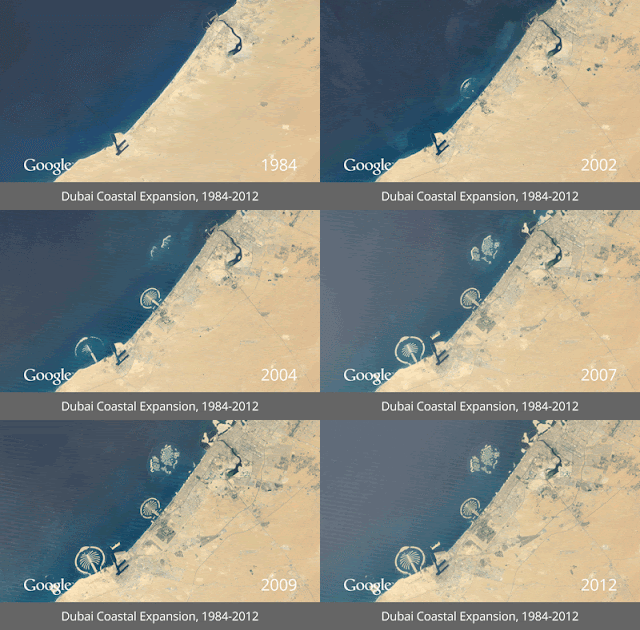
Another city whose phenomenal growth has come with massive alterations to the environment is Dubai. Once a city of about 300,000 with an economy based on pearl diving, Dubai has become a major metropolis and the Mideast’s financial center with the world’s tallest skyscraper, the largest mall, biggest theme park and the longest indoor ski run. Its population is currently 2.1 million and growing. Islands (two in the form of palm trees) have been created and, as in Las Vegas, expansion continues into the desert.
Just as there is a “red list” for endangered species, scientists are developing one for ecosystems and it is high time indeed. The massive loss of rain forests, the shrinking of glaciers and the advance of cities in the desert as revealed via the Google Earth Engine show too clearly why too many ecosystems around the globe are deeply endangered.
MORE AT: Buzzfeed and The Blaze
"Destroying the New World Order"
THANK YOU FOR SUPPORTING THE SITE!
Latest Activity
- Top News
- Everything
715995407_27066569266338656_4621890679891427521_n
"cheeki kea I was born in Los Angeles, California and I will never go back there! The Democrats have…"
What was the “Flying Pig” as the Germans Called it?
In 1943 the Eighth Air Force was in a deadly quandary. The US Air Force had no fighter aircraft at…See More
How they Planned the Destruction of America (And Nearly Succeeded)
In 2020 The Democrats went on a major offensive. Prevent Donald Trump from taking office, continue…See More
It's Over. The Tool Bans Just Arrived!
First tool ban is here! A new law was just signed in New York that requires blueprint blocking technology on every CNC machine, laser cutter, lathe and 3D pr...
Angry Old Man James Carville Warns of More to Come?
A new type of signaling is brewing among the left and disenfranchised Democrats who have refused…See More
© 2026 Created by truth.
Powered by

