US raises stakes on Iran by sending in ships and missiles
Source
Pentagon says Patriot shield will deter strike on American allies in the Gulf
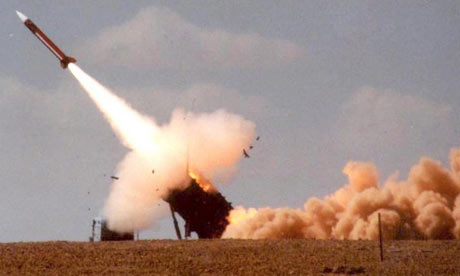
Pentagon says Patriot shield will deter strike on American allies in the Gulf
Tension between the US and Iran heightened dramatically today with the disclosure that Barack Obama is deploying a missile shield to protect American allies in the Gulf from attack by Tehran.
The US is dispatching Patriot defensive missiles to four countries – Qatar, United Arab Emirates, Bahrain and Kuwait – and keeping two ships in the Gulf capable of shooting down Iranian missiles. Washington is also helping Saudi Arabia develop a force to protect its oil installations.
American officials said the move is aimed at deterring an attack by Iran and
reassuring Gulf states fearful that Tehran might react to sanctions by
striking at US allies in the region. Washington is also seeking to
discourage Israel from a strike against Iran by demonstrating that the US is prepared to contain any threat.
The deployment comes after Obama's attempts to emphasise diplomacy over confrontation in dealing with Iran – a contrast to the Bush
administration's approach – have failed to persuade Tehran to open its
nuclear installations to international controls. The White House is now
trying to engineer agreement for sanctions focused on Iran's
Revolutionary Guard, believed to be in charge of the atomic programme.
Washington has not formally announced the deployment of the Patriots and other
anti-missile systems, but by leaking it to American newspapers the
administration is evidently seeking to alert Tehran to a hardening of
its position.
The administration is deploying two Patriot batteries, capable of shooting down incoming missiles, in each of the
four Gulf countries. Kuwait already has an older version of the
missile, deployed after Iraq's invasion. Saudi Arabia has long had the
missiles, as has Israel.
An unnamed senior administration official told the New York Times: "Our first goal is to deter the
Iranians. A second is to reassure the Arab states, so they don't feel
they have to go nuclear themselves. But there is certainly an element
of calming the Israelis as well."
The chief of the US central command, General David Petraeus, said in a speech 10 days ago that
countries in the region are concerned about Tehran's military ambitions
and the prospect of it becoming a dominant power in the Gulf: "Iran is
clearly seen as a very serious threat by those on the other side of the
Gulf front."
Petraeus said the US is keeping cruisers equipped with advanced anti-missile systems in the Gulf at all times to act as a buffer between Iran and the Gulf states.
Washington is also concerned at the threat of action by Israel, which is predicting that
Iran will be able to build a nuclear missile within a year, a much
faster timetable than assessed by the US, and is warning that it will
not let Tehran come close to completion if diplomacy fails.
The director of the CIA, Leon Panetta, met the Israeli prime minister,
Binyamin Netanyahu, and other senior officials in Jerusalem last week
to discuss Iran.
Pro-Israel lobby groups in the US have joined Republican party leaders in trying to build public pressure on the
administration to take a tougher line with Iran. One group, the Israel
Project, has been running a TV campaign warning that Iran might supply nuclear weapons to terrorists.
"Imagine Washington DC under missile attack from nearby Baltimore," it says. "A
nuclear Iran is a threat to peace, emboldens extremists, and could give
nuclear materials to terrorists with the ability to strike anywhere."
Washington is also concerned that if Iran is able to build nuclear weapons, other
states in the region will feel the need to follow. Israel is the only
country in the Middle East to already have atomic bombs, although it does not officially acknowledge it.
The US secretary of state, Hillary Clinton, said in London last week that
the US will press for additional sanctions against Iran if it fails to
curb its nuclear programme.
Europe's foreign affairs minister, Catherine Ashton, today said the UN security council should now take up
the issue. "We are worried about what's happening in Iran. I'm
disappointed at the failure of Iran to accept the dialogue and we now
need to look again at what needs to happen there," she told Sky News.
"The next step for us is to take our discussions into the security council.
When I was meeting with Hillary Clinton last week we talked about Iran
and we were very clear this is a problem we will have to deal with."
However, China and Russia are still pressing for a diplomatic solution.
Tony Blair, Middle East envoy on behalf of the US, Russia, the UN and the
EU, continually referred to what he described as the Iranian threat
during his evidence at the Chilcot inquiry last Friday. Textual
analysis now shows that he mentioned Iran 58 times.
Besides the new missile deployment, Washington is also helping Saudi Arabia to
create a 30,000-strong force to protect oil installations and other
infrastructure, as well as expanded joint exercises between the US and
military forces in the region.
The move is a continuation of the military build-up begun under former president George W Bush. In the
past two years, Abu Dhabi has bought $17bn (£11bn) worth of weapons
from the US, including the Patriot anti-missile batteries and an
advanced anti-missile system. UAE recently bought 80 US-made fighter
jets. It is also buying fighters from France.
Petraeus said in a speech in Bahrain last year the UAE air force "could take out the entire Iranian air force, I believe".
Missile defence
Patriot missiles are designed to intercept enemy missiles before they reach
their target. Since production began in 1980, 9,000 missiles have been
delivered to countries including Germany, Greece, Taiwan and Japan.
During the first Gulf war Patriot success was 70% in Saudi Arabia and 40% in
Israel. Since then the US has spent more than $10bn (£6.3bn) improving,
among other aspects, the system's radar and computer compatibility for
joint forces action. Once in position, the system requires a crew of
only three people to operate. Each missile weighs 700kg and has a range
of about 100 miles.
The US navy is in the process of upgrading all its Ticonderoga class cruisers and a number of destroyers to carry
the Aegis ballistic missile defence system. It uses a surface-to-air
missile that is capable of intercepting ballistic missiles above the
atmosphere. It has also been tested on failing satellites as they fall
to earth. Each missile is over 6m long and costs more than $9m. James Sturcke
"Destroying the New World Order"
THANK YOU FOR SUPPORTING THE SITE!
Latest Activity
- Top News
- Everything
Linda Moulton Howe Reopens the Antarctica Mystery With New Claims
Linda Moulton Howe has reopened a file she guarded for twenty-five years, and nearly every witness inside it is now gone. It holds testimony about Antarctica...
FB_IMG_1790355245884
"There was no 6 million! See Red Cross, put Jewish deaths during WWII at 277,000! German…"
The De-intellectualizing of the West!
One of the saddest aspects of reducing a society into chaos and division is propaganda, which is…See More
The file of shame - Zandvoort - one of the largest covered-up paedophile scandals
Enjoy the videos and music you love, upload original content, and share it all with friends, family, and the world on YouTube.
Alaskan Triangle US Air Force Loses 5 Aircraft
The year is 1950 and the US and Soviet Union are locked in a crucial arms race that epitomizes the…See More
Is this an Undeclared War We are Technologically Losing?
Incident No. 1The year is 1980 and in US Air Force records this incident is still classified so…See More
THE PAPER CHAINS
"Well from now on this fight is up to Amerian People to win it. I'm afraid that all wars you…"
Top German Panzer Ace of WWII Meets His End Finally
On the battlefields of the eastern and western fronts there was a scourge for the Germans who had…See More
Big Lonely: An Indie Film that Will seriously Affect You
It's easy for us to be caught up in our little world, feeling sorry for ourselves, or lamenting the…See More
© 2026 Created by truth.
Powered by

