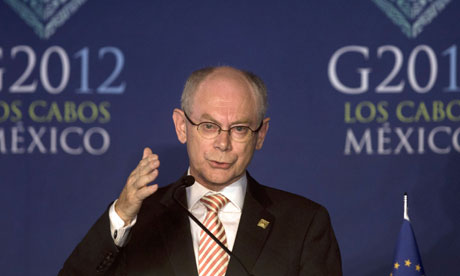
European leaders have drafted a radical plan to turn the 17 countries of the eurozone into a full-fledged political federation within a decade in an attempt to placate the financial markets by demonstrating a political will to save the single currency in the medium-term.
The incendiary proposals for banking, fiscal, and economic unions resulting in a "political union" are to be debated at an EU summit on Thursday and Friday. Following two bad-tempered meetings of European leaders in Mexico and Rome over the past week, the Brussels summit looks likely to see major clashes over the future of Europe as well as the immediate crisis surrounding sovereign debt, bad banks and the euro's survival.
The crisis has shifted from the periphery of the EU to its very heart, with Berlin and Paris seriously at odds for the first time since the Greek drama started 30 months ago. The logic of the draft proposals will also pose major dilemmas for David Cameron, perhaps putting Britain at a crossroads in its relationship with the continent.
The seven-page document, obtained by the Guardian, has been drafted by the "gang of four" – a quartet of European presidents: Herman Van Rompuy of the European Council, Mario Draghi of the European Central Bank, José Manuel Barroso of the European commission, and Jean-Claude Juncker of the 17-country eurogroup.
It calls for a quick start on establishing a new European banking union, says that the ECB could be given supervisory authority over EU banks quickly, and proposes common resolution funds (for winding up bad banks, funded by a banking levy to spare EU taxpayers) as well as a common deposit guarantee scheme for Europe's savers.
Berlin is already pooh-poohing the notion, unwilling to "mutualise" liability for other country's savers or banks any time soon. The paper also says that the eurozone's new permanent bailout fund, the European Stability Mechanism (ESM), could be used as the "fiscal backstop" for a banking union, opening the way to direct recapitalisation of troubled banks, also opposed by the key power, Germany.
Britain is adamantly opposed to joining a banking union and placing much of Europe's biggest financial centre, the City, under the authority of the ECB. Arguing that the union should be purely eurozone as a response to the euro crisis, Cameron will demand "safeguards" quarantining the British financial sector while ensuring that any new financial regime does not impair Britian's interests in the EU's single market.
The Germans appear reluctant to offer any concessions, though, and the draft says the banking union should extend beyond the eurozone.
"An integrated financial framework should cover all EU member states, whilst allowing for specific differentiations between euro and non-euro area member states on certain parts of the new framework that are preponderantly linked to the functioning of the monetary union and the stability of the euro area rather than to the single market."
Analysts say that a banking union cannot work without a eurozone fiscal union and the paper proposes sweeping new eurozone powers, including options, fiercely resisted by Berlin, for sharing liability for the debt of eurozone countries – eurobonds. The paper seeks to accommodate German objections by bowing to chancellor Angela Merkel's new mantra – "no liability without controls".
"In a medium term perspective, the issuance of common debt could be explored as an element of such a fiscal union and subject to progress on fiscal integration. Steps towards the introduction of joint and several sovereign liabilities could be considered as long as a robust framework for budgetary discipline and competitiveness is in place to avoid moral hazard," the paper says.
"Progress in the pooling of decisions on budgets would be accompanied with commensurate steps towards the pooling of risks. Several options for partial common debt issuance have been proposed, such as the pooling of some short-term funding instruments on a limited and conditional basis, or the gradual roll-over into a redemption fund. Different forms of fiscal solidarity could also be envisaged."
Full fiscal union, the paper says, will ultimately require what is tantamount to a eurozone finance ministry – "the development at the euro area level of a fiscal body, such as a treasury office".
On budgetary and economic policy-making, the proposals ramp up the powers of EU or eurozone authorities to dictate and enforce national decision-taking, for example, on labour markets or "tax co-ordination".
It also suggests that European authorities could intervene to ensure national civil service and other reforms, as is currently being tried as part of the Greek bailout.
"Measures to strengthen the political and administrative capacity of national institutions and foster national ownership of reforms could be taken where necessary, as this is a vital condition for the efficient implementation of growth-enhancing reforms."
The gang of four paper calls for much more intrusive eurozone powers over national budgets, fiscal and economic policy-making.
"Upper limits on the annual budget balance and on government debt levels of individual member states could be agreed in common. Under these rules, the issuance of government debt beyond the level agreed in common would have to be justified and receive prior approval. Subsequently, the euro area level would be in a position to require changes to budgetary envelopes if they are in violation of fiscal rules."
The four presidents ask for a mandate from this week's summit to draw up "a specific and time-bound road map for the achievement of genuine Economic and Monetary Union", stating they should deliver an interim report in October and more detailed plans by the end of the year.
There are certain to be major conflicts over the proposals before that happens. The likelihood is that the banking union can be established without having to resort to the hazardous step of re-opening the EU's Lisbon Treaty. But the other ambitions would require reopening the EU's decade-old quandary over a European constitution.
France will be deeply reluctant to surrender so much sovereign powers to new eurozone authorities, while Germany will only accept liability for others if the powers are federalised.
Amid deepseated Franco-German divisions, Merkel is to go to Paris on the eve of Thursday's summit to try to strike a deal with French president François Hollande.
The Wednesday evening dinner is being preceded today by talks in Paris between the German, French, Spanish, and Italian finance ministers.
For the master plan to work, Germany would also need a new Basic Law or constitution, as suggested at the weekend by Wolfgang Schäuble, the finance minister.
Hollande would have a hard time delivering a socialist party still deeply divided on Europe ever since the French voted against a European constitution in 2005. Hollande's foreign minister, Laurent Fabius, spearheaded the No campaign.


You need to be a member of 12160 Social Network to add comments!
Join 12160 Social Network