First Analysis of the Opening Ceremonies
Via: http://www.redicecreations.com/article.php?id=20927
First Analysis of the Opening Ceremonies
2012 07 27
By Jaime Weinman | Macleans.ca
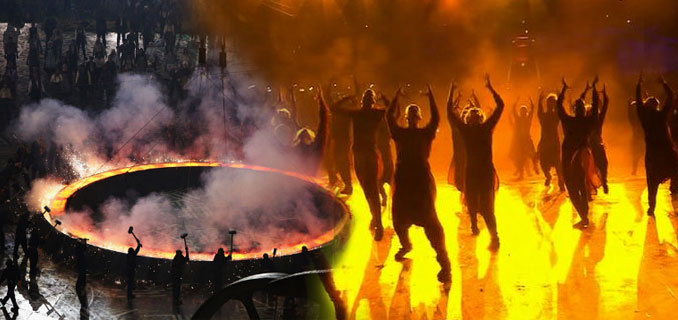
An Olympic opening ceremony is sort of like a comedy monologue at the Academy Awards: so much time, planning and money goes into the creation of a performance that’s only vaguely related to what we came to see. We watch the Olympics to see the best athletes from around the world, while indulging our pardonable rooting interest in our own country. But the Opening Ceremonies aren’t exactly about athletics, and they aren’t really about the world. They’re a big commercial for the host city and the host country, and they’re judged in large part by how positive an image they convey. The last Summer Games ceremony, in Beijing in 2008, became instantly famous as an example of how a ceremony can help sell the world on a country’s favoured image of itself. The idea of China as a huge country with incredibly efficient and skilled people wasn’t new, of course, but the ceremony made it even more vivid and popular.
So, naturally, a lot of the talk before this year’s ceremony was about the image of Great Britain that Danny Boyle planned to project. And one thing was clear from the beginning–the ceremony was drenched in history. Some countries try to offer a sleek, modern image, implying that this is Year Zero and they’re looking ahead to the future. China in 2008 offered its share of historical facts, but the overall impression it gave was of a forward-looking, modern place.
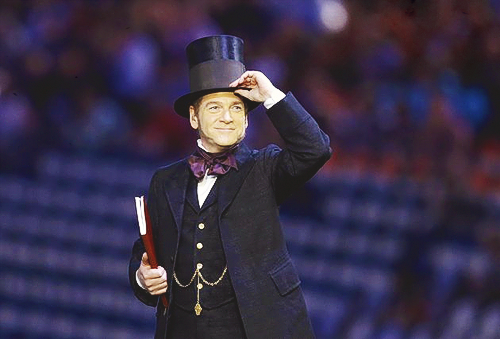
Boyle, on the other hand, offered a great big nostalgia show. As soon as Kenneth Branagh came out to recite Shakespeare in a costume that many of us couldn’t help mistaking for Abraham Lincoln, this was a show about all the old stuff that it’s still safe for England to be proud of. (The Empire tends to be soft-pedaled these days.) It was by no means uncritical nostalgia, but it was still a celebration of the English landscape, British heritage, the parts of the Women’s Suffrage movement that weren’t already covered in full in Mary Poppins. By the time we got to the dancing tribute to the NHS, it seemed almost inevitable.
Also seemingly inevitable, but still thrilling, was the meeting between James Bond and the Queen. There’s something charming and wonderful about seeing a cliché come to life through the magic of filmmaking. And since we all know that Bond and Elizabeth are the two most famous English people outside of England (well, maybe Sherlock Holmes too, but there are so many different versions at once) seeing them together was exciting. And in a ceremony that tried – in a halting sort of way – to portray England as something more than the tourist version, this was a pretty funny portrayal of the version of England that we outsiders are familiar with.
Boyle tried, as much as he could, to bring a bit of a political edge to the show: portraying the bad as well as the good points of the Industrial Revolution, celebrating Socialized Medicine™, and giving us a gigantic Peace Sign Busby Berkeley formation. It’s not exactly revolutionary stuff, but it’s one of the elements that gave a slightly personal dimension to a production that is, by its nature, huge and impersonal. If Danny Boyle wants to send a message to David Cameron, at least that’s something we don’t see in an opening ceremony every single time.
The riskier thing about this show is how much of it was focused on the past. By the time they got to the part that focused on young people and their cell phones and hippie dancing, we’d already been through a huge amount of time devoted to Great Britain’s past. Even the “modern” segments were full of clips of old TV shows, movies, and songs, putting modern young people alongside a black-and-white clip of one of England’s most famous émigrés, Charlie Chaplin. In an era when many countries try to avoid too much nostalgia, this ceremony wallowed in the sense of British pride in past accomplishments, in cultural exports, in its status as the place that created many of the fictional characters we grew up with.
The danger of such an approach is that it can create a sense that a country is looking back on its best days, and that things will never be as good again. If the opening show created that feeling, it’s hardly unique to Britain. In difficult times, countries all around the world can’t avoid a sense of good times lost, that the future won’t be as good as the past. This was a ceremony where even the internet seemed to be part of a better time gone by, in the person of World Wide Web creator Tim Berners-Lee, a representative of a time when anything seemed possible.
It might be that nostalgic feeling, it might be the weather, or it just might be that Danny Boyle is not a naturally high-spirited director, but this definitely didn’t seem like a high-spirited escapist show. It found things to celebrate, but there was a sense of bleakness underlying the fun. (In true British fashion, even the scenes with children were by no means escapist; they don’t go for the idea that childhood is a time of cuteness and pure enjoyment.) The closest thing to an escapist scene was the one celebrating those crazy dancing teens, but it was still a somewhat glum vision of the world.
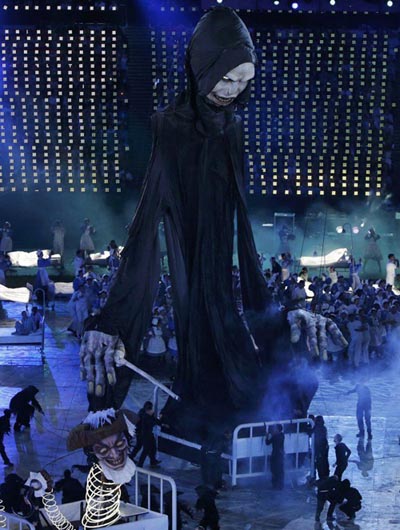
And a little bit of glumness is probably inevitable and even appropriate for the first summer opening ceremony to be fully planned and staged after the economic collapse. Some shows are displays of opulence, Cecil B. DeMille spectacles where we’re meant to gape at the amount of money and that went into it. That was the effect of the drumming scene at Beijing in 2008; it was supposed to make our eyes pop out in awe of what money and manpower can accomplish. This was more a show for the recession era, where lavishness isn’t in the best of taste, and there’s almost a hidden longing to strip away the trappings of our era and begin again with the things that work: dancing, modern medicine, grass, trees, and, of course, plugs for James Bond movies. And in contrast to the Beijing ceremony, famous for its corporate, collective emphasis on a huge number of people doing the same thing in the same way, Boyle was trying (not always succeeding, but trying) to bring a more humanist feel to the show, highlighting individual characters and costumes.
My impression of the show, then, was somewhere in between. I don’t think it was a bad show at all, but there was a sense that a certain excitement and joy was missing at times. The iconic image of the show might be Kenneth Branagh in his top hat, standing in the middle of a crowd of dancing people, with an unlit cigar in his mouth and doing absolutely nothing. The expression on his face says: I’m here, and I’m kind of enjoying it, but you’d have to pay me a lot more to actually join in the dance.
[...]
Article from: macleans.ca
"Destroying the New World Order"
THANK YOU FOR SUPPORTING THE SITE!
Latest Activity
- Top News
- Everything
Engineers of Human Souls | A/POLITICAL Introduction to Laibach
a/political Introduction to @LaibachOrg is the forth episode in the series.Laibach is amongst the most notorious and misunderstood music and artistic group...
Oil News ( not good )
"~ Amendment. New hope on the horizon. Quick updates. Diesel sanctions on Russia Lifted ! by…"
The Death Doll-Halloween Story Two
Retired Major Lionel Eldridge was browsing items in a bazaar of relics, antiques, and curios when…See More
TDS
"ps.. Does anyone think this mental illness is viral escaping beyond the boarders of the USA ?,…"
Cast a Giant Shadow (1966) - Trailer
Directed by: Melville ShavelsonYear: 1966Country: USAGenre(s): Drama, History, WarSYNOPSIS:In this fact-based film, distinguished U.S. Army Col. David Marcus...
" Scrubbed from the internet? The idiots photographed themselves!!! “Conspiracy…"
A Halloween Story
I’d made a reservation for a cabin a day before Halloween was to fall. I guess watching little…See More
"rlionhearted, That's a question I've asked from thevery beginning! What the hel;l was…"
"Less Prone, they are not just folling us they are killing innocent citizens and non-combatants for…"
The Conformist (1970) Original Trailer [HD]
Directed by Bernardo Bertolucci. With Jean-Louis Trintignant, Stefania Sandrelli and Gastone Moschin.The Conformist Blu-ray : https://amzn.to/3QruE5FThe Conf...
How Ukraine Revolutionized Warfare and Stopped Putin
A war that Vladimir Putin sold to his people that would be a cake walk that would be over in a few…See More
© 2026 Created by truth.
Powered by

