ASSANGE EXTRADITION
ASSANGE EXTRADITION: Legal Teams Likely Informed Already of Judge’s...
According to usual practice, both the prosecution & defense have most likely been informed of the judge’s decision on Julian Assange’s extradition case, though normal procedure is to not yet inform the defendant or his family, writes Alexander Mercouris.
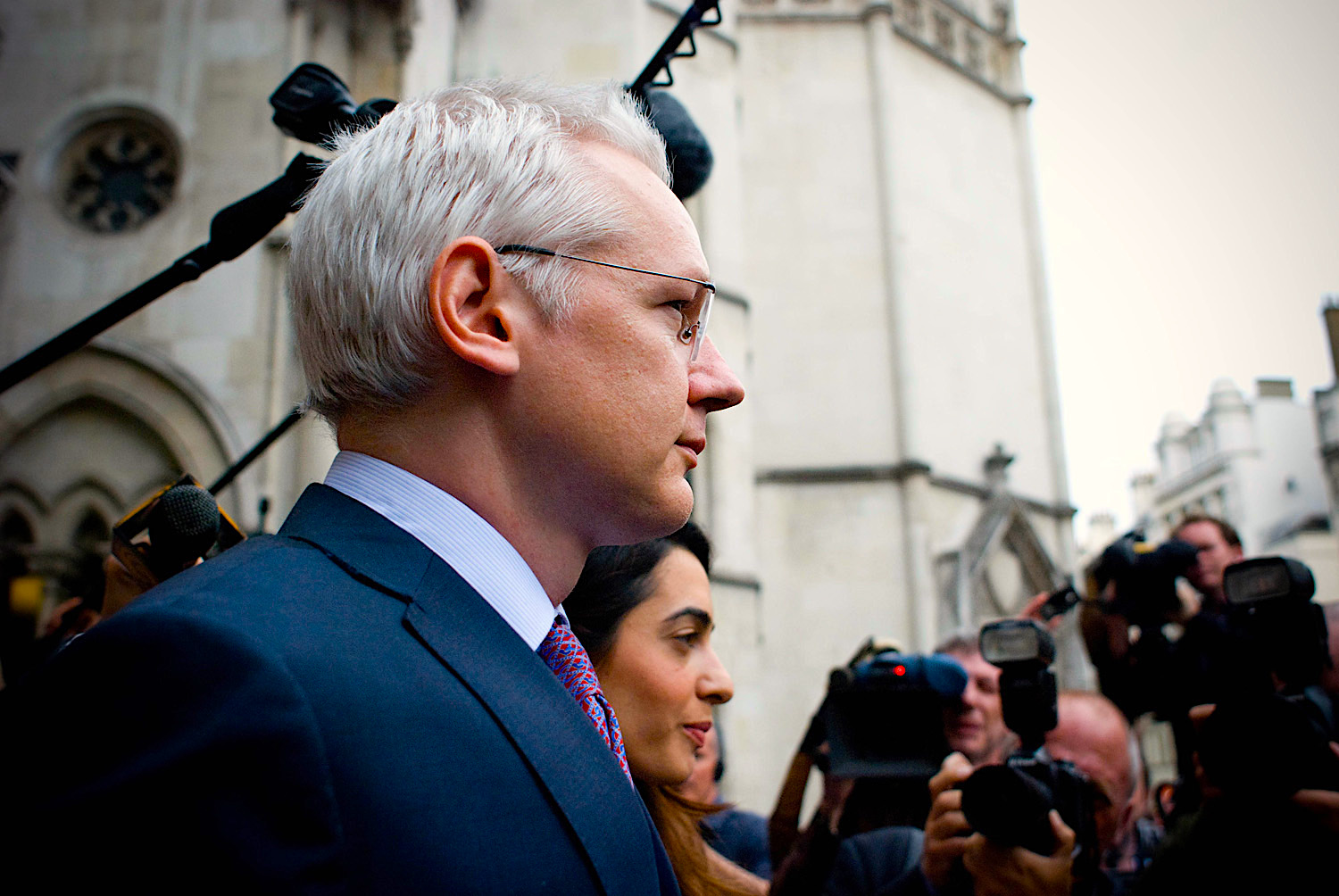
Assange outside British Supreme Court, 2011. (acidpolly/Flickr)
By Alexander Mercouris
in London
Special to Consortium News
 In accordance with a British magistrate court’s usual procedure, Julian Assange’s Judgment has almost certainly already been written and sent in draft form to the respective teams of lawyers, probably early on Friday evening.
The lawyers therefore already know what the decision is, as well as the British government and at least the Department of Justice in Washington.
Under established procedure, Assange’s lawyers are not supposed to tell Assange himself what the decision is so he and his family are probably the only people who are directly involved in his case who don’t yet know its outcome.
The purpose in sending the Judgment in draft form to the lawyers in advance of the Court hearing is to give them an opportunity to check it for factual mistakes.
The public will not know the outcome until Magistrate Vanessa Baraitser reads out the Judgment in its finalised form, with any factual mistakes corrected, when Court convenes on Monday at 10 am London time. The Judgment should then be published online by the Court Service directly after she has finished.
In addition to the Judgment – and obviously to the decision whether or not to extradite, which will be set out in the Judgment – the public may learn immediately afterward whether either of the two sets of lawyers intend to appeal. Either side has seven days to appeal the judgment.
While the intent of allowing both sides to see the Judgment in advance is not to help facilitate an appeal, having the judgement before it is read to the court affords attorneys a chance to consider whether or not to launch one.
If It’s a Split Decision
One possibility that must be considered is that Baraitser may decide to extradite on one indictment and not on the other, for instance, if she rules against extradition on the Espionage Act charges, but decides in favour of extradition on the conspiracy to commit computer intrusion charge (which carries a maximum five year sentence as opposed to 170 on espionage.)
Assange’s frail health and the harsh U.S. prison conditions outlined by defense witnesses at his hearing might influence Baraitser to go with the lesser computer charge.
What is likely to happen in that case is that the British authorities would accept Baraitser’s decision and would try to reach an agreement with the DoJ whereby, in return for Assange’s extradition, the U.S. would commit itself to try Assange only on the computer intrusion charges, and not on the Espionage Act charges.
The British over the course of the negotiations would tell the U.S. that if the U.S. were not willing to give that commitment then the British would not be able to extradite Assange to the U.S.
Of course the British (if Assange were extradited to the U.S. on such a basis) would be in no position to compel the U.S. to abide by such a commitment if the U..S were to go back on it once Assange was on U.S. soil.
Since that has to be a very likely possibility, one would think it would be a point which Assange’s lawyers would make in the appeal they would be bound to make to the High Court against Baraitser’s decision to extradite on the computer charge.
In fact in such a scenario it’s not impossible that both sides would appeal to the High Court:
(1) the U.S. against Baraitser’s decision to refuse to extradite on the basis of the Espionage Act;
(2) Assange’s lawyers against Baraitser’s decision to extradite on the computer intrusion charges.
It would be a fascinating battle and it would be fascinating to see how it would play out.
Logically, the balance ought to tip in Assange’s favour since Baraitser would presumably have rejected extradition on the Espionage Act charges because they were not properly made out and because they were overtly political.
In light of that, would the High Court be prepared to allow Assange’s extradition on computer intrusion charges to a country which had tried unsuccessfully to bring overtly political charges against him which the lower Court had rejected?
Nothing is predictable in this case.
Appeal Scenarios
In the event that Baraitser decides the case in Assange’s favour, and the U.S. government decides to appeal, there is also the question of whether or not Assange will be released pending the outcome of the appeal, or whether he will continue to be kept in detention in Belmarsh.
Journalist Glenn Greenwald in his latest article assumes that Assange will remain in detention throughout the appeal process, but that is not certain.
Since there would be a Court Judgment saying that extradition had been refused, and since Assange is not being held because of any crime committed in the United Kingdom, and as there is no outstanding prison sentence imposed on him by any British Court, one would think that Baraitser in her Judgment would order his immediate release.
British authorities might take steps to rearrest him (perhaps on still more, new U.S. charges) immediately as the order for his release is made. But it seems certain that Assange’s lawyers would make an prompt application, either to Baraitser or to a High Court judge for Assange’s immediate release, which given a hypothetical decision in his favour, Baraitser or the High Court judge would probably grant.
Given Baraitser’s demeanour in court during Assange’s hearing, and given several of the decisions she made, the greater likelihood is that she will rule in favour of U.S. extradition on both indictmments, in which case Assange would almost certainly remain in Belmarsh prison while his legal team appeals. If she should pursue a split decision there would be a stronger likelihood that Assange would continue in detention until the appeal were decided because the Court would have decided to allow his extradition to the U.S.
However even in that case Assange’s lawyers would still be in a position to apply for bail on the grounds that the most serious and important part of the case made by the U.S. for his extradition (the Espionage Act charges) had been refused, and that his appeal against the remaining part (the computer intrusion charges) was likely to be successful.
The public and Assange himself will know in less than 48 hours.
Alexander Mercouris is a legal analyst and editor of The Duran.
Comment
"Destroying the New World Order"
THANK YOU FOR SUPPORTING THE SITE!
Latest Activity
- Top News
- Everything
In 1994, He Exposed Their Entire System… and Predicted 2026 Perfectly. | Jordan Maxwell
In 1994, He Exposed Their Entire System… and Predicted 2026 Perfectly. | Jordan Maxwell#jordanmaxwell #knowledge #technology #history #facts✅ Explore Jordan ...
Halloween Story No. 4 “The Curse”
Arnold Yates had spent 20 years in big city law enforcement. Ten years as a Cop and 10 years as an…See More
Rock Hudson - " Seconds " Trailer - 1966
Along "Giant" , "Seconds" remained one of Rock's favorite of his movies.The film was based on David Ely' s novel.Rock was finding himself pigeonhelded in co...
A Disturbing Pattern Happened Again... Explain This
#strange #video #strangevideos #scary #scaryvideos #creepy In this video we dig into strange, disturbing, and odd stories that sit just outside nor...
Halloween Story Number Three- “They Came from the Sky!"
Werner was from Westphalia, Germany-the Northwest Region. He had been in America for a few months…See More
🚨 THEY SILENCED HIM! Barrie Jennings' SHOCKING 9/11 Testimony… Then He MYSTERIOUSLY DIED! (RIP)
‼️ WARNING: This Story Will Make You Question Everything…Barry Jennings was a key witness to the UNEXPLAINED explosions inside WTC Building 7 on 9/11—long be...
NAZA Official Trailer | Mongrel Media
The trailer for NAZA, a new documentary from Yuval Abraham and Rachel Szor, two of the Oscar®-winning filmmakers behind NO OTHER LAND.Shot at night on the ro...
Pentagon's LifeLog vs. Facebook: Same Day Shutdown? #shorts
LifeLog, the Pentagon's ambitious data collection program, was shut down by DARPA on February 4th, 2004. Coincidentally, Facebook was registered as a busines...
The Fantasy Clown World I Wake Up to Everyday
I never could have seen this coming before I was awakened by all the BS that I became aware of…See More
Why Was the Movie “The Bedford Incident” Such a Threat?
With wars looming in the Middle East and Vladimir Putin making more threats of using nuclear…See More
Oil News ( not good )
"~ Amendment. New hope on the horizon. Quick updates. Diesel sanctions on Russia Lifted ! by…"
The Death Doll-Halloween Story Two
Retired Major Lionel Eldridge was browsing items in a bazaar of relics, antiques, and curios when…See More
© 2026 Created by truth.
Powered by


You need to be a member of 12160 Social Network to add comments!
Join 12160 Social Network