The Fall of Greece Yes, It Really is a Capitalist Plot
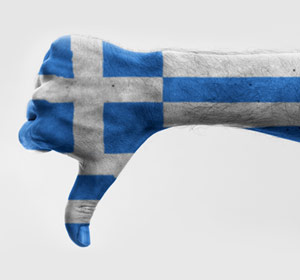
For Europe’s poorest countries, European Union membership has long held out the promise of tranquil prosperity. The current Greek financial crisis ought to dispel some of their illusions.
There are two strikingly significant levels to the current crisis. While primarily economic, the European Economic Community also claims to be a community, based on solidarity -- the sisterhood of nations and brotherhood of peoples. However, the economic deficit is nothing compared to the human deficit it exposes.
To put it simply, the Greek crisis shows what happens when a weak member of this Union is in trouble. It is the same as what happens on the world scale, where there is no such morally pretentious union perpetually congratulating itself on its devotion to human rights. The economically strong protect their own interests at the expense of the economically weak.
The crisis broke last autumn after George Papandreou’s PASOK party won elections, took office and discovered that the cupboard was bare. The Greek government had cheated to get into the EU’s euro zone in 2001 by cooking the books to cover deficits that would have disqualified it from membership in the common currency. The European Treaties capped the acceptable budget deficit at 3 per cent and public debt at 60 per cent of GDP respectively. In fact, this limit is being widely transgressed, quite openly by France. But major scandal arrived with revelations that Greece’s budget deficit reached 12.7 per cent in 2009, with a gross debt forecast for 2010 amounting to 125 per cent of GDP.
Of course, European leaders got together to declare solidarity. But their speeches were designed not so much to reassure the increasingly angry and desperate Greek people as to soothe “the markets” – the real hidden almighty gods of the European Union. The markets, like the ancient gods, have a great old time tormenting mere mortals in trouble, so their response to the Greek problem was naturally to rush to profit from it. For instance, when Greece is obliged to issue new bonds this year, the markets can blithely demand that Greece double its interest rates, on grounds of increased “risk” that Greece won’t pay, thus making it that much harder for Greece to pay. Such is the logic of the free market.
What the EU leaders meant by “solidarity” in their appeal to the gods was not that they were going to pour public money into Greece, as they poured it into their troubled banks, but that they intended to squeeze the money owed the banks out of the Greek people.
The squeezing is to take the forms made familiar over the past disastrous decades by the International Monetary Fund: the Greek state is enjoined to cut public expenses, which means firing public employees, cutting their overall earnings, delaying retirement, economizing on health care, raising taxes, and incidentally probably raising the jobless rate from 9.6 per cent to around 16 per cent, all with the glorious aim of bringing the deficit down to 8.7 per cent this year and thus appeasing the invisible gods of the market.
This just might propitiate both the gods and German leaders, who above all want to maintain the value of the euro. The financial markets will no doubt grab their pound of flesh in the form of increased interest rates, while the Greeks are bled by IMF-style “shock treatment”.
And what about that great theater of human rights and universal brotherhood, the European Parliament? In that forum everyone gets to speak for a carefully clocked 1, 2, or 3 minutes, but when it comes to the most serious matter, the budget, the authoritative voices are all German.
Thus the chairman of the EP’s special committee on the economic and financial crisis, Wolf Klinz, has called for sending a “high representative” of the EU to Greece, an “economies commissar” to make sure the Greeks carry out the austerity measures properly. The Greek crisis can allow the EU to put into practice for the first time its “Treaty instruments” concerning “supervision of budgetary and economic policy”. Interest rates may go up because of “risk”, but there is to be no risk. The pound of flesh will be delivered.
There was no such supervision of the financial fiddling which caused this mess. The EU statistics agency Eurostat recently discovered and revealed that in 2001, Goldman Sachs secretly (“but legally”, protest its executive officers) helped the right-wing Greek government meet EU membership criteria by using a complicated “currency swap” that masked the extent of public deficit and national debt. [See Andrew Cockburn and Marshall Auerback, on this site.] Who understands how that worked? I think it is fair to guess that not even Angela Merkel, who is trained as a scientist, understands clearly what went on, much less the incompetent Greek politicians who accepted the Goldman Sachs trickery. It allowed them to create an illusion of success – for a while. Success meant being a “member of the club” of the rich, and it can be argued that this notion of success has actually favored bad government at the national level. Belonging to the EU gave a false sense of security that contributed to the irresponsibility of incompetent political leaders.
Having euros to buy imported goods (notably from Germany) pleased rich consumers, while the euro priced Greek goods out of their previous markets. Now the debt trap is closing. The traditional way out for Greece would be to leave the euro and return to a devaluated drachma, in order to cut imports and favor exports. This way, the burden of necessary sacrifices would not be borne solely by the working class. But the embrace of EU “solidarity” is there to prevent this from happening. German authorities are preparing to lay down the law to the Greeks, after reducing the income of their own working class in order to benefit Germany’s export-oriented economy.
Austerity measures are the opposite of what is needed in a time of looming depression. Rather, what is needed are Keynesian measures to stimulate employment and strengthen the domestic market. But Germany is firmly attached to the export model, for itself and everyone else (“globalization”). For a country like Greece, which cannot compete successfully within the EU, exports outside the EU are crippled by its use of a strong currency, the euro. Bound to the euro, Greece can neither stimulate its domestic market nor export successfully. But it is not going to be allowed to extricate itself from the debt trap and return to its traditional currency, the drachma. Poverty appears to be the only solution.
There is discontent within the German working class at their country’s policies aimed at shrinking wages and social benefits for the sake of selling abroad. In an ideal “social Europe”, workers in Germany would come to the aid of workers in Greece by demanding a radical revision of economic policy, away from catering to the international financial markets toward building a solid social democracy. The reality is quite different.
The Greek financial crisis exposes the absence of any real community spirit in the EU. The “solidarity” declared by the country’s EU partners is a solidarity with their own investments. There is no popular solidarity between peoples. The EU has established a surrogate ideology of internationalism: rejection of the nation-state as source of all evil, a pompous pride in “Europe” as the center of human rights, giver of moral lessons to the world, which happens to fit in perfectly with its subservience to United States imperial foreign policy in the Middle East and beyond. The paradox is that European unification has coincided with decreasing curiosity in the larger EU states about what happens to their neighbors.
Despite a certain amount of specialized training needed to create a Eurocrat class, the general population of each EU member is only superficially acquainted with the others. They see them as teams in soccer matches. They go on holiday around the Mediterranean, but this mostly involves meeting fellow tourists, and study of foreign languages has declined, except for English (omnipresent, if mangled). Mass media news reports are turned inward, featuring missing children and pedophiles ahead of even major political events in other EU member states.
Northern European media portray Greece practically as a Third World country, peripheral and picturesque, where people speak an impossible language, dance in circles on islands, and live beyond their means in their carefree way. The crickets in the Aesop fable, scorned by the assiduous ants.
Media in Germany and the Netherlands imply that IMF-style shock treatment is almost too good for them. The widening polarization between rich and poor, between and within EU member states, is taken for granted.
The smaller indebted countries within the EU are amiably designated by the English-speaking financial priesthood as the PIGS – Portugal, Italy (perhaps Ireland), Greece, Spain – an appropriate designation for an animal farm where some are so much more equal than others.Diana Johnstone is a frequent contributor to Global Research. Global Research Articles by Diana Johnstone
Source: Global Research.ca, March 7 2010
Comment
"Destroying the New World Order"
THANK YOU FOR SUPPORTING THE SITE!
Latest Activity
- Top News
- Everything
"rlionhearted, That's a question I've asked from thevery beginning! What the hel;l was…"
"Less Prone, they are not just folling us they are killing innocent citizens and non-combatants for…"
The Conformist (1970) Original Trailer [HD]
Directed by Bernardo Bertolucci. With Jean-Louis Trintignant, Stefania Sandrelli and Gastone Moschin.The Conformist Blu-ray : https://amzn.to/3QruE5FThe Conf...
How Ukraine Revolutionized Warfare and Stopped Putin
A war that Vladimir Putin sold to his people that would be a cake walk that would be over in a few…See More
Linda Moulton Howe Reopens the Antarctica Mystery With New Claims
Linda Moulton Howe has reopened a file she guarded for twenty-five years, and nearly every witness inside it is now gone. It holds testimony about Antarctica...
FB_IMG_1790355245884
"There was no 6 million! See Red Cross, put Jewish deaths during WWII at 277,000! German…"
The De-intellectualizing of the West!
One of the saddest aspects of reducing a society into chaos and division is propaganda, which is…See More
The file of shame - Zandvoort - one of the largest covered-up paedophile scandals
Enjoy the videos and music you love, upload original content, and share it all with friends, family, and the world on YouTube.
Alaskan Triangle US Air Force Loses 5 Aircraft
The year is 1950 and the US and Soviet Union are locked in a crucial arms race that epitomizes the…See More
Is this an Undeclared War We are Technologically Losing?
Incident No. 1The year is 1980 and in US Air Force records this incident is still classified so…See More
© 2026 Created by truth.
Powered by


You need to be a member of 12160 Social Network to add comments!
Join 12160 Social Network