Battery Could Provide a Cheap Way to Store Solar Power
Battery Could Provide a Cheap Way to Store Solar Power
Combining aspects of high-energy lithium-sulfur batteries with flow battery technology can lower costs.
April 26, 2013
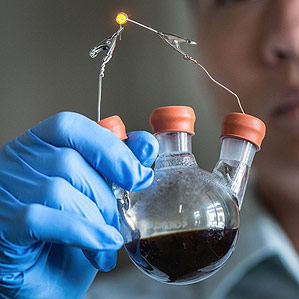
Flask battery: A new kind of flow battery lights up a small LED. The battery stores energy in a sheet of lithium metal and materials dissolved in a liquid electrolyte.
There’s a promising new entry in the race to build cheap batteries for storing energy from solar panels and wind turbines. Stanford researchers led by Yi Cui, a professor of materials science and engineering, have demonstrated a partially liquid battery made of inexpensive lithium and sulfur. Cui says the battery will be easy to make and will last for thousands of charging cycles.
Cui believes that the material and manufacturing costs of the battery might be low enough to meet the Department of Energy’s goal of $100 per kilowatt-hour of storage capacity, which the DOE estimates will make the technology economically attractive to utilities. Existing batteries can cost hundreds of dollars per kilowatt-hour of capacity, although several companies are working to commercialize cheaper ones (see “Ambri’s Better Battery” and “Battery to Take On Diesel and Natural Gas”).
The technology is a cross between a flow battery and an experimental type called a lithium-sulfur battery. In a flow battery, positive and negative liquid electrolytes are stored in swimming-pool-size tanks. The batteries are attractive because the amount of energy they store can be increased simply by expanding these tanks, without increasing the size of the electronic connections and other battery parts needed to extract the energy. But they require expensive ion membranes and large amounts of material.
Lithium-sulfur batteries, meanwhile, consist of two solid electrodes connected by a liquid electrolyte. They have the potential to store large amounts of energy, but they’ve been hard to commercialize because they can’t be recharged often enough. The problem is that compounds called lithium polysulfides, which form during the charging and discharging process, tend to dissolve in the electrolyte, leaving the lithium and sulfur inaccessible for future charging cycles. With each recharge, more energy capacity is lost, limiting the life of these batteries.
But Cui saw that this phenomenon could be useful in a flow battery, where energy is stored in the electrolyte and not in a solid electrode. Indeed, the dissolved lithium polysulfide stores more energy than the materials usually used in flow batteries, such as vanadium, so less material is needed. That, and the fact that lithium and sulfur cost less than vanadium, could help lower the cost of flow batteries.
What’s more, Cui says, his modified flow battery needs no ion membrane. Only one of the electrodes is a liquid; the other is metallic lithium. An inexpensive coating on the lithium serves the purpose of the membrane, allowing ions but not electrons to move between the lithium metal and the polysulfides. That is key to both protecting the lithium and creating an electrical current.
Challenges remain before the battery can be commercialized. For example, the number of times it can be recharged, while currently impressive for a lithium-sulfur battery, still needs to be improved for the technology to be economically competitive. Cui’s battery has been charged 2,000 times, but the DOE target is 5,000 recharges.
Even to reach 2,000 cycles, he needed to include extra lithium in the battery to accommodate the fact that the metal degrades a bit with each charging cycle.
The extra lithium adds to the cost, which could make it harder to meet the target of $100 per kilowatt-hour.
http://www.technologyreview.com/news/514266/battery-could-provide-a...
Tagged: Energy, Materials, solar power, battery, wind power, power grid, flow battery, lithium sulfur
Replies to This Discussion
-
Permalink Reply by Not mainstreamer on
-
Cui’s battery has been charged 2,000 times, but the DOE target is 5,000 recharges.
1000 charges is exellent. My batteries tend do destruct before 2 years.
DEO = The United States Department of Energy (DOE) is a Cabinet-level department of the United States government concerned with the United States' policies regarding energy and safety in handling nuclear material.
the Department of Energy’s goal of $100 per kilowatt-hour of storage capacity, which the DOE estimates will make the technology economically attractive to utilities.
This number of "$100" is not meaningful. We cannot put mobile power together with utility power. It will be like comparing price of a sailing boat windmill with our usual electricy bills.
"Destroying the New World Order"
THANK YOU FOR SUPPORTING THE SITE!
Latest Activity
- Top News
- Everything
Oil News ( not good )
"~ Amendment. New hope on the horizon. Quick updates. Diesel sanctions on Russia Lifted ! by…"
The Death Doll-Halloween Story Two
Retired Major Lionel Eldridge was browsing items in a bazaar of relics, antiques, and curios when…See More
TDS
"ps.. Does anyone think this mental illness is viral escaping beyond the boarders of the USA ?,…"
Cast a Giant Shadow (1966) - Trailer
Directed by: Melville ShavelsonYear: 1966Country: USAGenre(s): Drama, History, WarSYNOPSIS:In this fact-based film, distinguished U.S. Army Col. David Marcus...
" Scrubbed from the internet? The idiots photographed themselves!!! “Conspiracy…"
A Halloween Story
I’d made a reservation for a cabin a day before Halloween was to fall. I guess watching little…See More
"rlionhearted, That's a question I've asked from thevery beginning! What the hel;l was…"
"Less Prone, they are not just folling us they are killing innocent citizens and non-combatants for…"
The Conformist (1970) Original Trailer [HD]
Directed by Bernardo Bertolucci. With Jean-Louis Trintignant, Stefania Sandrelli and Gastone Moschin.The Conformist Blu-ray : https://amzn.to/3QruE5FThe Conf...
How Ukraine Revolutionized Warfare and Stopped Putin
A war that Vladimir Putin sold to his people that would be a cake walk that would be over in a few…See More
© 2026 Created by truth.
Powered by

