How the Desperation of 1942 Became the path to Victory
The year is 1942 and the situation in the Pacific theater of war is in grave doubt. The Japanese time table of conquest had led to the disaster at Pearl Harbor, the siege of Corregidor, General Mac Arthur’s stronghold falling into the Imperial Japanese forces hands leading to the Bataan Death March, while the Philippines, Malaysia, Indonesia, Singapore, and planned landings in New Guinea as well as Port Moresby in Australia! Despite the efforts of India and Australian troops who fought retiring actions trying to slow the advance of the Japanese Imperial Army significant territories fell to the Axis forces.
Yet, even in this most desperate of years of World War II, the Pacific fleet under Admiral Chester Nimitz went on the attack. CINCPAC command made the decision to conduct a series of hit and run raids in the Solomon Islands and the Marianas that kept the superior naval power of the Japanese off balance and guessing at the whereabouts of the US Navy. The Japanese plan was to draw the US carrier forces into decisive battles to annihilate what remained of the American fleet. However, fate would not play into the hands of the Japanese. Just weeks after the tragedy of Pearl Harbor the Doolittle Raid was launched and the Japanese Imperial forces were completely caught off guard. Though the squadrons of B-25 Billy Mitchell bombers forced to take off hundred of miles too soon thus losing their bid for landing in safe Chinese held airstrips, did meager damage but that shock of having their homeland bombed helped keep a large number of military assets tied up in Japan rather than adding to the already numeric superiority the Japanese had-11 aircraft carriers to just 3 for the US Navy operational in the Pacific.
While the USS Hornet was accommodating the Doolittle Raid the Battle for the Coral Sea was about to commence and two carrier forces of the US Navy were hunting the Japanese landing flotillas who were poised to land amphibious assaults on New Guinea and Port Moresby. The first carrier duel between the US and Japan happened here. With the US striking first on an air raid at Tulagi badly damaged the carrier Shoho sunk while trying to refuel aircraft on deck. Frank Fletcher’s command stopped a superior Japanese contingent thanks to deciphered radio traffic between Japanese command. As a result of this engagement the Imperial forces were denied their amphibious landings and the heavy losses following the next morning caused both forces to withdraw. This was the first time that a Japanese invasion had been halted and turned back.
US losses on left of chart and Japanese losses on the right
Casualties and losses |
|
1 fleet carrier sunk, |
1 light carrier sunk, |
In another month the most pivotal engagement of the Pacific theater would be the Battle of Midway and the crushing defeat for the Japanese losing 4 carriers, a heavy cruiser, and hundreds of veteran combat pilots that they could not afford to lose, but sadly the USS Yorktown heavily damaged but still underway and undergoing repair, was torpedoed by a Japanese sub dooming her to rest at the bottom of the ocean! This bloody victory for the US Navy would lead to the first US Marine landings on Guadalcanal to take a Japanese air strip and assemble US Air power in the region.
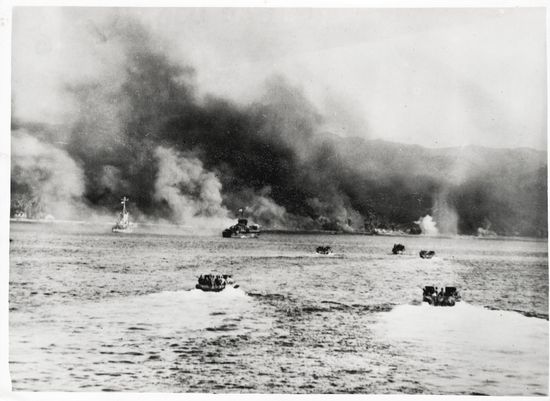
With the rescue of Wake Island being abandoned US carrier forces would later inflict what many would call the “Revenge for Pearl Harbor” Raid on Lae-Salamaua, an air raid that would lead to a disastrous loss of ships in the harbor, the strafing and destruction of Japanese aircraft on the ground, and the death of the base commander! It was victories like this that won back American morale and taught the US Navy valuable lessons on carrier borne operations!
Breakdown of the 1942 Raid
The strike on March 10, 1942, conducted by aircraft from the USS Lexington and USS Yorktown, significantly hindered Japanese expansion plans in New Guinea. [1]
- Troop Casualties: 130 killed (6 army, 126 navy) and 250 wounded.
- Ships Sunk: Kongō Maru, Tenyō Maru, and Yokohama Maru (transports); Tama Maru No. 2 (auxiliary minesweeper).
- Ships Damaged: Light cruiser Yūbari, 2 destroyers, a minelayer, a seaplane tender, and a transport.
In months to come, further offensive operations against Lae and Salamanaua would lead to 14,000 Japanese casualties!
We will now take a sobering look on losses suffered by the US Navy in 1942 alone!
In 1942, the U.S. suffered devastating naval losses in the Pacific, notably losing four fleet aircraft carriers (Lexington, Yorktown, Wasp, and Hornet) alongside six heavy cruisers, dozens of destroyers, and multiple submarines. These losses peaked during the brutal Coral Sea, Midway, and Guadalcanal campaigns.
However, in the deadly war of attrition in the Pacific, the Japanese lost precious veteran pilots, carrier commanders, and warships they could never replace at the rate that US industrial output could replenish American losses! By 1942 27 Essex Class Carriers were being deployed to enter the Pacific Theater of war and further grind down the Japanese war machine, but it would take 3 bloody years of an island hopping campaign that would end in the atomic weapons known as “Fat Man” and “Little Boy” dropped from B-29 Super Fortresses to finally convince the Japanese political leadership to end the war! In 1942 alone an estimated 62,000 naval personnel were lost from carriers, submarines sank, destroyers, and cruisers.
Hopefully, our public schools and universities will teach young minds in the future that heavy cost of freedom that was paid for by the blood of young American pilots, troops, submariners, and civilians operating the Merchant Marine ships so that America and the world could prevent totalitarian control over our peoples. The lessons of history should never be allowed to be forgotten!
Comment
"Destroying the New World Order"
THANK YOU FOR SUPPORTING THE SITE!
Latest Activity
- Top News
- Everything
"Um err... is it whatever the brain believes it to be, will manifest. You know what, there really…"
The future of ai exposed in new ad 😱 *must see* #palantirtechnologies #ai #conspiracy
Enjoy the videos and music you love, upload original content, and share it all with friends, family, and the world on YouTube.
Who was the Better Drummer Paul McCartney or Ringo?
In contrast to the earlier interviews with Paul McCartney before the alleged fatal car accident in…See More
THE END: 2046
Hello again my fellow travelers in life. Today, I will not delve into politics, the economy,…See More
"Just to show I am still around... :P"
The Undeclared Ongoing War With China
Just one day after meeting with President Trump in China. Xi Ji Ping has a meeting with Russian…See More
The US Federal Government Who is Really in Charge? Tulsi Gets Raided?
Just 24 hours ago the office of Intelligence Director, Tulsi Gabbard was raided by the CIA at…See More
The Latest Craze
Their demonic little waysThe news is just a biased arrayThe higher taxes they want you to…See More
A Banished Poet
"An interesting snippet from world poetry day this year to learn of the first poet excited from the…"
FB_IMG_1772349325558
"Good Point! Our Indo European friends in Iran gave the devil a good write down ( and Jesus a…"
© 2026 Created by truth.
Powered by


You need to be a member of 12160 Social Network to add comments!
Join 12160 Social Network